Your Health, Our Insights
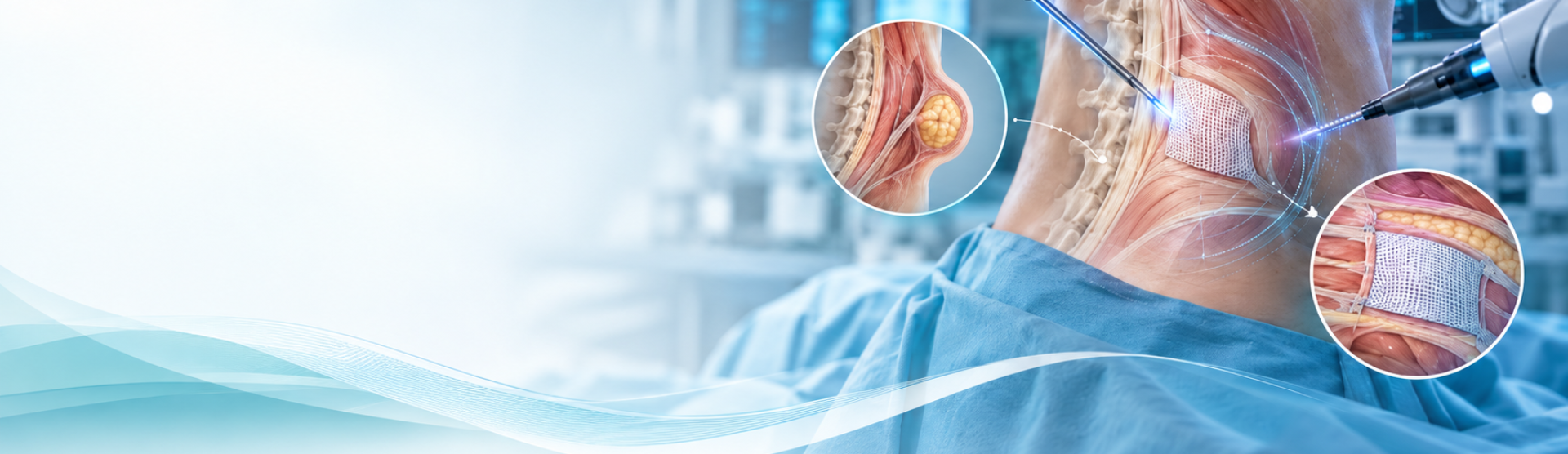
Redefining Primary and Traumatic Lumbar Hernia Repair: Precision, Innovation, Outcomes
Lumbar hernias are rare defects of the posterolateral abdominal wall, usually at Grynfeltt’s or Petit’s triangles (≈95%). About 20% are congenital, 80% acquired (primary or secondary). Defects vary from <5 cm to >8 cm.
🔹 CT imaging (96% sensitivity) remains the gold standard for diagnosis.
🔹 Primary lumbar hernia: recurrence 1.6–3.5%, chronic pain 2–5%, infection ≤2%.
🔹 Meta-analysis (10,771 pts, 2025): recurrence ↓ to 4.5% (laparoscopic) vs 5.9% (open) — significant advantage (OR 0.66, p=0.0003).
🔹 Dual-mesh tension-free and preperitoneal reinforcement techniques enhance long-term strength.
🔹 Robotic repair emerging — recurrence < 2%, hospital stay ≈ 1.8 days, minimal wound morbidity.
💥 Traumatic lumbar hernia (211 cases, 1993–2023):
• Mean age 52 yrs | 96% CT-diagnosed | 86.8% inferior type
• 8% recurrence overall
• Defect ≥ 8 cm → 100% sensitive for mesenteric injury at acute presentation
• Open extraperitoneal mesh = has been gold standard for > 8 cm defects; laparoscopy for smaller, clean cases.
But Robot is expanding its utility for larger hernias needing tension free mesh reinforced repairs (unilateral TAR ).
• Robotic repair offers superior 3-D visualisation and ergonomics with <2% recurrence, mean 1.8-day stay, and faster recovery.
• Tension-free dual-mesh reinforcement (sublay + onlay) ensures structural stability for large or traumatic defects, achieving 0–2% recurrence and excellent pain outcomes.
💢 Chronic Pain and Mesh Complications
• Long-term chronic pain 2–5%, comparable across open, laparoscopic, and robotic approaches.
• Mesh infection ≤2%; seroma more common after open repair; bowel injury risk slightly higher laparoscopically.
💡 Surgeon expertise remains the strongest predictor of recurrence and chronic pain — skill matters more than technique.
✨ The future: Imaging precision + tension-free mesh + robotic finesse = safer, faster, stronger repairs.
You might like these articles

Book Now