Your Health, Our Insights
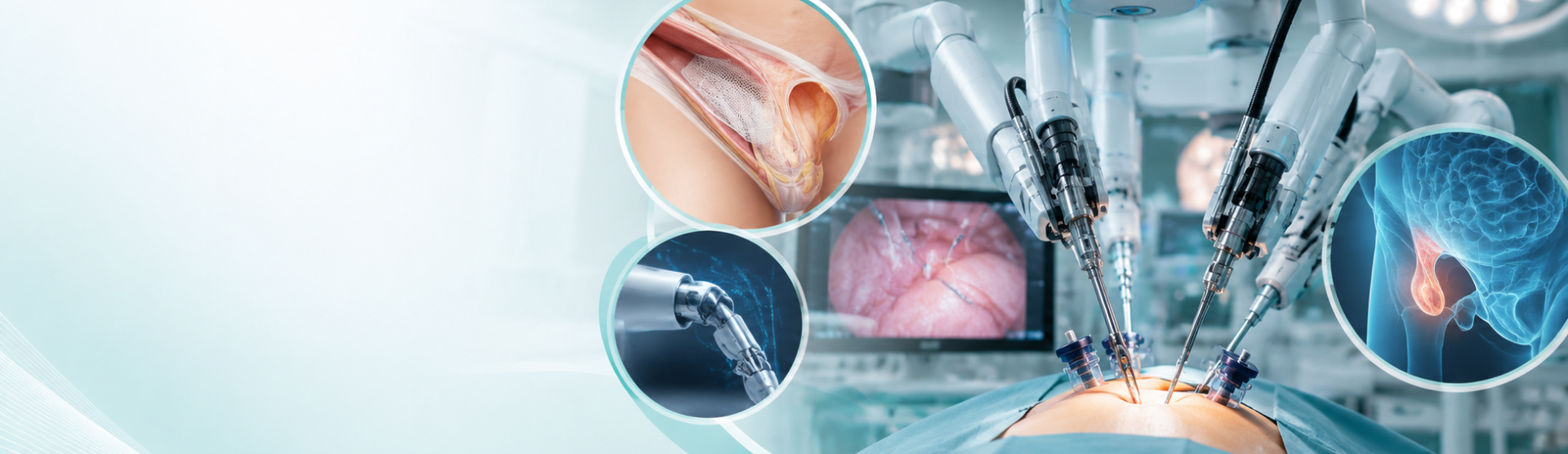
Could a robot one day repair an inguinal hernia without the surgeon’s hands?
sounds futuristic.
But the technology needed to seriously consider the question is already emerging.
1️⃣ WHERE ARE WE TODAY?
Current Robotic assisted models:
SURGEON ON CONSOLE→ ROBOT → PATIENT
Autonomous surgery would require something fundamentally different:
AI PERCEPTION → SURGICAL PLAN → ROBOTIC EXECUTION → CONTINUOUS FEEDBACK
And that raises a much bigger question:
Can a robot understand anatomy well enough to operate safely?
2️⃣ WHY INGUINAL HERNIA SURGERY?
Inguinal hernia repair is potentially an attractive model for surgical automation.
Why?
Because a robotic TAPP procedure contains a relatively structured sequence:
• Identify the relevant anatomy
• Develop the preperitoneal plane
• Reduce the hernia sac
• Identify critical structures
• Achieve adequate myopectineal coverage
• Position the mesh
• Close the peritoneum
Many of these steps are repetitive, measurable and anatomically constrained.
That makes them potentially suitable for task-specific automation.
⸻
3️⃣ THERE IS ALREADY A PROOF OF CONCEPT
Autonomous soft-tissue surgery is no longer purely theoretical.
Experimental platforms such as the Smart Tissue Autonomous Robot (STAR) have demonstrated autonomous suturing in animal models.
This is an important milestone.
However, we must be precise:
Autonomous suturing in an experimental model ≠ autonomous human hernia repair.
The gap remains substantial.
⸻
4️⃣ THE REAL CHALLENGE? NOT MOVING THE INSTRUMENTS.
The robot can already move instruments with remarkable precision.
The harder problem is understanding what it is seeing.
Consider:
• Previous mesh
• Dense adhesions
• Scar tissue
• Distorted anatomy
• Unexpected vessels
• Recurrent hernia
A surgeon can recognise that the operative situation has changed and adapt immediately.
An autonomous system must do the same.
Most importantly, it must know when to say:
“I am no longer sufficiently confident and STOP 🛑 .”
That ability may be more important than the ability to perform the surgical manoeuvre itself.
⸻
5️⃣ THEN COMES THE CLINICAL QUESTION
No clear clinical superiority of robotic over conventional laparoscopic repair.
* Learning curve may influence robotic outcomes.
* Standardised anatomical steps may not always be followed.
* Long-term evidence remains limited, especially for chronic pain and recurrence.
* Autonomy should not assume robots are better than surgeons.
Key question:
Can automation improve safety, consistency and efficiency?
⸻
6️⃣ WHAT MIGHT THE FUTURE LOOK LIKE?
Perhaps not:
ROBOT vs SURGEON
But:
SURGEON + AUTONOMOUS ROBOT
A possible pathway:
Robot assistance
↓
Automated camera and simple tasks
↓
Supervised autonomous suturing
↓
Autonomous components of hernia repair
↓
Highly autonomous routine surgery with human oversight
And when uncertainty exceeds a predefined threshold:
STOP → SURGEON TAKES OVER
You might like these articles

Book Now